Factory Zero gains insight into shop floor progress through digitalisation
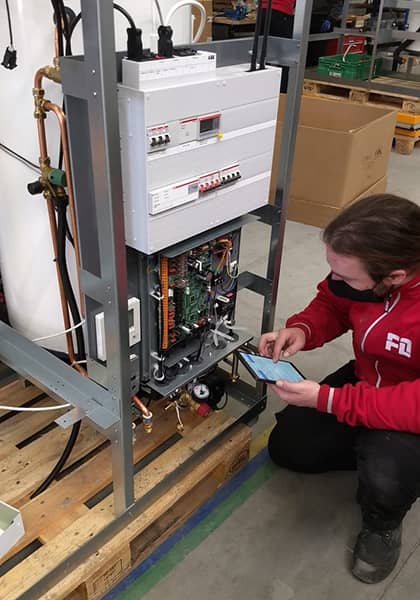
Factory Zero from Tiel in the Netherlands wants to make the energy transition achievable and above all affordable for everyone. We hear a lot about it lately: ‘getting off gas’, ‘sustainable energy’ and ‘heat pumps’. Factory Zero’s contribution is the integrated Climate Energy Module (iCEM). All the relevant technologies for a highly energy-efficient installation for new-build and renovation are (re)developed in Tiel and produced on an industrial scale – and where possible circularly. Factory Zero has a production capacity of more than 1,500 energy modules a year, achieved with a growing team of 40 employees.
The fast-growing company realises its ambition together with innovative partners from various industries. For example, Factory Zero is working with construction group Dijkstra Draisma and façade partner Rc Panels on the renovation factory ‘Future Factory’, which will produce 25,000 smart tech façades and roofs a year from 2025.
According to Rik Voorn of Factory Zero, this mission can only succeed with a strong supply chain and well-digitalised processes. “I believe in partnership with suppliers, because you grow together. In fact, we are only as good as our worst supplier. Our method is to plan from the preliminary specification. We then have a production slot about twelve weeks later, followed by a call-off three weeks before delivery. The construction industry is not used to such a tight schedule. So our puzzle starts with a forecast for modules that have 293 parts, supplied by 188 suppliers. Of course I could think in terms of stock – that gives certainty. But stock costs money and I don’t want warehouses. I also believe in outsourcing, so that our job is final assembly. Stick to what you know. Besides production, delivery is an integral part of our process. If we get the keys to a house at 8 a.m., there is a new installation by the end of the day, including work on the roof. Keep in mind that skilled construction workers are an obstacle to growth; finding production staff is much less of a problem.”
“The strategic question is: what can we do less, and can we then do more? This industry moves so fast that in three years we will have different products.” Digitalisation affects two aspects of the business: insight into the production process and monitoring of the iCEM modules that have been delivered. The shop floor is organised around one-piece flow. While Exact for Manufacturing is essential for managing the supply chain (planning and purchasing), Smart Production Solutions runs the shop floor. Insight into progress lets production staff make their own choices on the one hand, and provides management information on takt times on the other. Where automation can still improve is in configuring the modules: in theory there are 16 million combinations of properties per module. Product configuration may be a next step in digitalisation.
Monitoring the iCEM modules is a true showcase of Industry 4.0. Each module has a built-in processor that stays in contact with the Google cloud via a 4G modem. This not only passes on energy-usage data for subscription billing in Exact Online, but also picks up faults and data for predictive maintenance.
“The structure of Exact for Manufacturing is logical and easy to explain,” says Rik Voorn, “but I still have some wishes for multi-level MRP. Smart Production Solutions does a good job of translating the tasks to be carried out to the shop floor.” Together with Factory Zero, Exact and SPS face a challenge of growth and innovation to facilitate the energy transition.
Stay in the loop.
A few times a year: new features, go-lives and stories from the shop floor. No spam, unsubscribe at any time.
